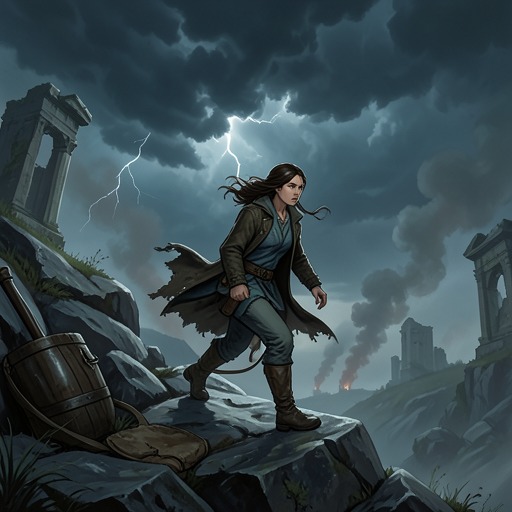
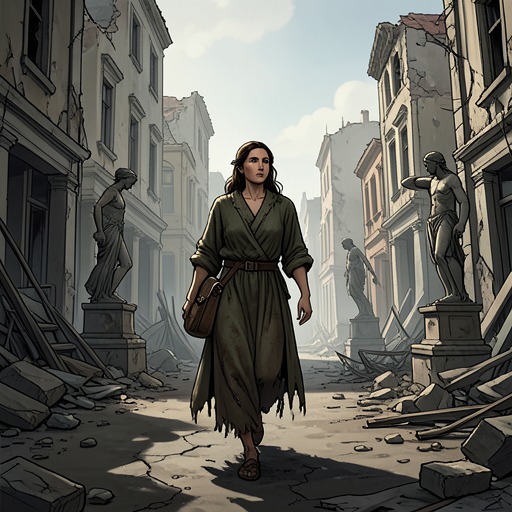
Event 1
Harrak Cataclysm
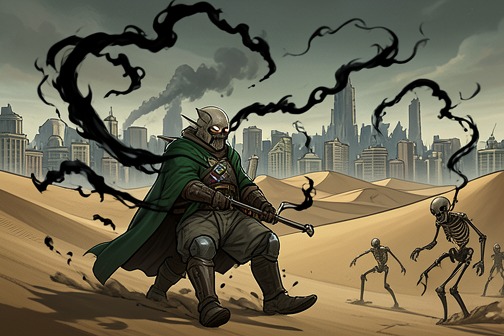
The [Harrak Cataclysm](entity:event-recall-event-b1d2ea37ba0c) was the terminal disaster of the [Old Empire](entity:time-recall-time-e286391f2d92), a magical destruction so immense that it erased [Harrak](entity:location-recall-location-harrak-0e455587e8ec)’s imperial center and left western [Param](entity:location-recall-location-param-7c5e7c9772bf) scarred by a permanent [Deadlands zone](entity:concept-recall-concept-572504aa76c3). It was not merely the fall of a city or dynasty: the catastrophe converted the heart of a once-dominant civilization into a hostile landscape of black mana, barren sand, ruined infrastructure, and mindless undead, while its surviving legacy continued to shape regional politics, military decisions, religious practice, and the routes available to later travelers.
## Causes and Imperial Context
The catastrophe occurred in Param, a large circular landmass on [Niyl](entity:location-recall-location-niyl-0d1dadf0165a) connected to its only neighboring continent by an isthmus no broader than a city. Param had once been fertile, but its western region bore the stigma of the greatest magical catastrophe ever recorded. Harrak, the Old Empire’s capital, had been the center from which imperial power terrified the world. Its elites reached levels of magical ability unknown elsewhere, yet the same concentration of power produced the experiment that destroyed them. The disaster therefore stands as the Old Empire’s defining contradiction: its civilization died at the apex of its strength, not after a gradual decline visible from outside.
Harrak’s position made the catastrophe more than a local ruin. The city had been the political and magical seat of an empire whose influence survived in the private collections of later peoples and in the languages of kings. When its central experiment turned against its makers, the destruction removed the imperial center while leaving behind dangerous remnants of its knowledge and power. The ruined capital became a cautionary example of uncontrolled [Magic](entity:concept-recall-concept-4828de91f32e), but it also remained an object of historical and geographical importance, since the surrounding region preserved the most direct evidence of what had happened.
## Physical Destruction and the [Deadlands](entity:location-recall-location-deadlands-5fe96675b09a)
From above, the western scar of the catastrophe resembled necrotic tissue on an otherwise healthy body. A vast valley lay enclosed by snow-capped mountain ranges, with only a small opening to the south. The center was darkest, while shrubs and enduring plants gave the outer areas a gradual greenish tint. This pattern records a gradient of devastation rather than a uniformly destroyed landscape: the closer the land lies to the epicenter, the more completely life has been overwhelmed.
The catastrophe’s central wound was Harrak itself. The city had been built with rigorous urban precision, extending for kilometers in estates, temples, churches, and squares. By the time of the surviving accounts, those streets were dark, empty, and dead. Beyond them stretched basaltic sand and distant mountains, while rubble as large as apartment buildings lay scattered across the plain. The scale of the debris made the ruined capital appear less like a conventional battlefield than a landscape struck by forces comparable to an asteroid impact or a tactical nuclear warhead.
The decisive evidence of the disaster’s origin lay at the top of the [Imperial Ziggurat](entity:location-recall-location-imperial-ziggurat-85f61e55f7ba). Where the summit had once stood was a gigantic crater, its edges molten and ragged from vitrified stone. The crater was too large to be explained by ordinary bombardment, and the surviving view made the crucial fact unmistakable: the destructive force had come from inside the pyramid. The Imperial Ziggurat was consequently both the visible monument of Old Imperial power and the body through which that power destroyed itself.
The city’s later remains made the same history even more stark. The imperial palace had been torn apart so completely that its remains were flung across the land, leaving the city center as a crater comparable to a volcano. Peeled earth exposed the area’s bony foundations, and Necrarchs covered the open ground in multitudinous grotesque forms. These undead were not simply inhabitants of a ruined city; they were continuing reminders of the consequences of the experiment and of the failure of imperial Magic to end when the empire died.
## Survival Conditions and Continuing Threat
After the catastrophe, only mindless undead were said to tread Harrak’s sandy corpse. The region offered no ordinary basis for recovery. Those who had previously camped there chose buildings for shelter despite the abundance of structures, implying that the area received no rain: exposed bodies would cool dangerously, while there was no practical reason to construct rain-repelling magical protection when intact buildings were available. The absence of precipitation was matched by the absence of renewable food. The land was described as utterly dead, without even a dried patch of grass, making famine and dehydration threats alongside the monsters.
The catastrophe also left behind a broad zone rather than a single lethal crater. As [Viviane Saint-Lys](entity:character-recall-character-viviane-saint-lys-4d8e1a89c44a) and [Solfis](entity:character-recall-character-solfis-bf2c0df8783e) approached the southern gap in the mountain range, the black mana began to fade. Dark shrubs appeared across the plains, and beyond the gap a dense, unmistakably living forest offered visible evidence that the Deadlands had an edge. Yet the transition was not safe. Zombies still dotted the plains, so the decline of magical saturation marked a possible route toward survival rather than a clean restoration of ordinary life.
For later societies, the Deadlands remained an active frontier. [Cernit](entity:character-recall-character-cernit-cbd1fe30cd55) reported that a necromancer had destroyed the two nearest forts, showing that the catastrophe’s environment could still support new military crises and hostile practitioners. In [Kazar](entity:location-recall-location-kazar-757924402955), the [Church of Neriad](entity:organization-recall-organization-bcf84df05d68) paid one iron bit for every [Revenant](entity:creature-recall-creature-revenant-a515d55201c7) head, and mercenaries used the city as a base for expeditions into the Deadlands. The church could verify kills, exorcise the corpses, or accept magical proof from burnt-out husks. A disaster centuries old had thus become part of a stable local economy, with religious institutions and armed specialists adapting their practices around its undead residue.
## Political and Social Afterlife
The Harrak Cataclysm reorganized the continent’s geography of power. Viviane Saint-Lys learned that she was at the western end of Param, while [Baran](entity:location-recall-location-baran-66dac900dc06) occupied the far eastern part and connected through the continent’s narrow isthmus to another large landmass. Between the Harrakan heartlands and Baran lay several other countries, including two large neighboring powers and numerous smaller territories. The map’s skull marking the Harrakan heartlands condensed the catastrophe into a political symbol: the former imperial core was still a recognized region, but it was represented as a place of death.
The disaster’s legacy also remained entangled with the histories of other peoples. Kazar belonged to [Enoria](entity:location-recall-location-enoria-7620864a9579), once a major kingdom before splitting in two fifteen years earlier after a failed coup, a purge of the nobility, and a bloody civil war. That later political fracture occurred far from the original imperial explosion, yet the region’s border-town institutions were shaped by proximity to the Deadlands and by the need for a strong church and mercenary presence. The Cataclysm therefore persisted not as an isolated historical memory but as one layer in a frontier system where old imperial ruins, newer civil conflicts, religious authority, and paid violence overlapped.
Its consequences also touched relations between humans and non-human peoples. In Kazar, [Marruk](entity:character-recall-character-marruk-4e4008323abd) was identified as a female [Kark](entity:creature-recall-creature-kark-97a1a78e3155) who had left what remained of her tribe. The Kark were undergoing severe hardships, while many northern free cities had formed the [Pure League](entity:organization-recall-organization-8097f50ec056) and subjected Kark to abuse. The Cataclysm did not directly cause these later conflicts, but the Deadlands’ frontier helped create the setting in which displaced peoples, mercenaries, church officials, investigators, and outsiders were judged through emergency practices and unstable political boundaries.
## Historical Meaning and Narrative Function
The catastrophe is introduced through its landscape before its full human history is explained. The ruined valley, empty imperial avenues, cratered ziggurat, and swarming Necrarchs make the past materially present. The Old Empire is absent as a living power, but its buildings and languages remain, while its failed experiment continues to govern movement and survival. This structure turns historical aftermath into an immediate force: Viviane Saint-Lys does not study a dead civilization from safety; she crosses the remains of its failure while seeking food, water, shelter, and a way out.
The destruction also creates a sustained contrast between imperial mastery and ecological helplessness. The Old Empire’s elites possessed unmatched magical ability and built monumental cities, yet their achievement ended in a crater whose force came from within. Later life survives only at the margins, where plants endure, black mana fades, and a living forest begins beyond the mountain gap. The Cataclysm’s deepest warning is therefore not simply that Magic can destroy. It is that a civilization can mistake command over extraordinary power for control over its consequences.
The event’s political afterlife gives the ruined center a second significance. Harrak is both a corpse and a node: an abandoned capital, a source of undead threats, a subject of expeditions, a reason for fortified borders, and a source of income for the Church of Neriad and mercenaries in Kazar. Its destruction ended the Old Empire, but it did not end the circulation of power around the imperial core. The Cataclysm remains the central historical fact through which the Deadlands, neighboring kingdoms, religious institutions, and frontier communities continue to understand their world.
Event 2
Viviane's Transmigration
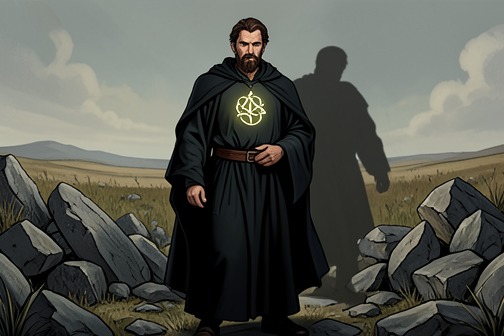
[Viviane's Transmigration](entity:event-recall-event-1d8348927228) is the foundational event that transports [Emeric](entity:character-recall-character-emeric-ed48e4ff1f0a) into Nyil and creates the identity through which the rest of the story unfolds. Planned as an escape from pursuit and as an opportunity to experience a female body, the transmigration is neither a clean rebirth nor a conventional possession: it destroys Emeric's original body, displaces a mortal soul, inserts his consciousness into a living woman, and leaves the result to awaken amid the ruins of the [Old Empire](entity:time-recall-time-e286391f2d92).
## Causes and Preparation
Emeric begins the passage as a powerful soul dissatisfied with the limits of his former existence. He has spent a lifetime pursuing knowledge and carefully curating books, yet learning cannot relieve the anguish in his heart; his suffering is framed as a problem even divine power cannot solve. Among the experiences denied to him for ages, he singles out a female orgasm, concluding that a polymorph spell would be too superficial to provide it. The transmigration therefore has both strategic and bodily motives: it is an evasion of [Maranor](entity:character-recall-character-maranor-505b86961d26), who might track him across worlds, and an experiment in inhabiting a womanly form.
The plan depends on concealment. Emeric reasons that Maranor would never expect him to incarnate voluntarily in a female body, and he treats this unexpected choice as evidence of his own brilliance. His prepared spell casts a small grid toward the radiant orb of his psyche, allowing him to search a distant world for a suitable host. The search begins with an enormous field of possibilities and is narrowed by preference rather than necessity. He eventually selects a sleeping woman with mesmerizing green eyes, a tall body, and a healthy tan, deciding simply that she will do.
## Crossing Worlds and Displacing the Host
The crossing destroys Emeric's body into its component atoms as soon as he moves through the space between worlds. The destination appears as a blue planet with broad yellow, white, and green landmasses, and Emeric assesses it with the detached curiosity of an explorer inspecting a promising environment. He notes the absence of planetoid-sized orbital squids and discovers that the world has no magic, as agreed, but possesses a surprisingly advanced technological civilization with metal tubes that fly and wealthy nations.
Once he has chosen the host, Emeric travels down into her body. The mortal soul is torn away in a single violent motion and held as a tiny white orb in his golden hand. He is fairly sure the process was painless, though the narration immediately undercuts that confidence. The uncertainty matters: the event is presented through Emeric's self-satisfied perspective, but the displaced woman's experience is not available to him and may not be available to the reader in full. Transmigration thus begins with an ethical rupture concealed beneath comic understatement.
Emeric also addresses the imbalance between the two realms by opening a minute portal to a power locus in his former world. He shoves the mortal soul through the gate, supplies enough energy for a body to reform, and leaves a tiny part of himself behind as well. He then congratulates himself as a benevolent god before completing the integration. The gesture solves a metaphysical accounting problem while preserving the event's moral asymmetry: Emeric treats a person's soul as something that can be transferred, repaired, and repurposed in service of his own plan.
## Awakening in [Harrak](entity:location-recall-location-harrak-0e455587e8ec)
The transplanted existence next appears in January 2013 at [Mopti Airport](entity:location-recall-location-mopti-airport-aad160d1013a) in Mali, where a tall woman wearing the beige uniform of the French special forces sleeps against sandbags with her hands clutching a rifle. Another woman kicks her thick body armor and orders her to wake. This modern military setting identifies the selected host as a trained soldier and gives the body a concrete life before the fantasy plot begins. The contrast is abrupt: a contemporary airport and military equipment stand at the edge of a sequence that will lead to an ancient magical catastrophe.
The result of the integration is then shown in the throne room of the emperor in Harrak. A figure stirs in pain, limbs locked in a death grip, before opening green eyes and emitting an ear-shattering scream. She scratches her naked body hard enough to draw blood while struggling against an aftershock that is partly memory and partly bodily estrangement. The remnant is too fragmentary to explain, yet intimate enough to make her want to kill herself; she cannot even determine whether the disturbance belongs to her nerves or to something deeper, a sense that her body does not quite fit.
This awakening makes the transmigration more than a change of location. The woman who rises in Harrak is burdened by an ordeal she cannot understand, while Emeric's earlier confidence has no visible place in the first physical aftermath. The thirty seconds she spends gulping air in quiet despair mark the immediate cost of the crossing: consciousness returns not as mastery, but as pain, confusion, and a fractured relation between soul and body.
## Nyil, Harrak, and the New [Interface](entity:concept-recall-concept-4fbcbc39735d)
The world receiving Viviane is Nyil, a planet of immense continents and seas. Its region of [Param](entity:location-recall-location-param-7c5e7c9772bf) contains the Western scar of the greatest magical catastrophe ever recorded: a vast valley ringed by snow-capped mountains, dark at its core and gradually reclaimed by enduring plants farther from the epicenter. The Old Empire once ruled from this territory, reaching unprecedented heights of magical ability before weaving its own destruction. Its capital, Harrak, remains a cursed city whose empty streets are dominated by the ruined [Imperial Ziggurat](entity:location-recall-location-imperial-ziggurat-85f61e55f7ba), while mindless undead cross the sandy remains.
The scale of the ruin becomes legible from the ziggurat's summit. A meticulously planned city of estates, temples, churches, and squares stretches for kilometers without movement, surrounded by basaltic sand and mountain ranges. Rubble as large as apartment buildings lies across the landscape, and the pyramid's former summit has been replaced by a gigantic crater with molten, vitrified edges. The impact resembles an asteroid strike or a tactical nuclear warhead rather than an ordinary military explosion. Viviane's first environment therefore joins personal dislocation to civilizational collapse: she awakens inside the corpse of an empire whose power has become a warning.
Her arrival is also formalized by the Interface. A light-blue window welcomes her to Nyil, identifies her as an [Outlander](entity:concept-recall-concept-38cf3a821ff6) transported to a new world, and states that every sapient being benefits from [Magic](entity:concept-recall-concept-4828de91f32e) under the guidance of [Nous](entity:character-recall-character-nous-5f15c3c8bdec) through the Interface. The single word that follows, Magic, converts an incomprehensible landscape into a system that can be learned. It also separates Viviane from ordinary inhabitants: her status as an Outlander is both an explanation for her displacement and the first administrative label imposed on her new life.
## Consequences and Narrative Significance
The event creates the central tension between Viviane's inherited modern competencies and Nyil's supernatural order. Her military body carries the memory of rifles, uniforms, and fortified airports, while her new existence must interpret a world of mana, undead, ruined imperial technology, and divine systems. Later movement through the [Deadlands](entity:location-recall-location-deadlands-5fe96675b09a) confirms the event's lasting transformation: black mana emission can make her appear less human and therefore less like a target, while powerful undead beings leak the same kind of black mana. The imported body and the magical world become visibly entangled.
Transmigration also initiates a trajectory from involuntary survival toward chosen action. In the Deadlands, Viviane rides a sled over the sand, exclaims in exhilaration, and then runs with an athlete's liberating pleasure, firing bolts of dark mana without the usual exhaustion or headache. The sequence turns the body's earlier alienation into a dangerous source of capability. Her cry of adventure is not proof that the original trauma has vanished; it is the beginning of a practical adaptation in which movement, combat, and dark power make continued existence possible.
The new identity is subsequently placed within a wider political and historical network. Through [Cernit](entity:character-recall-character-cernit-cbd1fe30cd55)'s map and [Solfis](entity:character-recall-character-solfis-bf2c0df8783e)'s interpretation, Viviane learns that she is at the Western end of Param, far from [Baran](entity:location-recall-location-baran-66dac900dc06) in the East and separated from the Harrakan heartlands by several countries. She later learns that [Kazar](entity:location-recall-location-kazar-757924402955) belongs to [Enoria](entity:location-recall-location-enoria-7620864a9579), a kingdom split fifteen years earlier after a failed coup, an attempted purge of the nobility, and a two-year civil war. Her arrival has therefore not merely moved her into a strange world; it has inserted her into the unfinished aftermath of imperial collapse and regional conflict.
The event's deepest counterpoint appears at the springs where Viviane stands before the veiled mummy of [Cassia the Unbroken](entity:character-recall-character-cassia-the-unbroken-092e9ef6f3e5). Cassia's presence reminds her that one person can reach the gods through deeds, and that Viviane remains alive because Cassia saved another soul centuries after the fall of the empire she defended. Viviane's crossing begins with Emeric taking a soul for private desire and strategic concealment; its later meaning is challenged by an older act of sacrifice that preserves life across centuries. That contrast gives the transmigration its decisive significance: it is an act of violation that nevertheless becomes the opening through which a new person can survive, choose, and eventually inherit responsibilities far larger than the original plan.
Event 3
Designation of Princess Bob
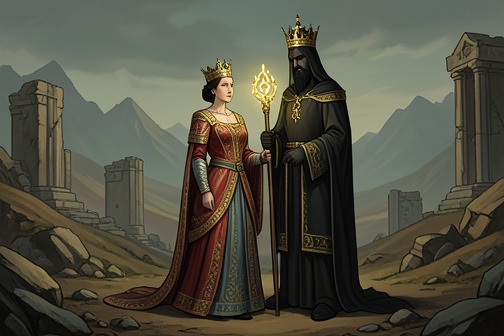
[Designation of Princess Bob](entity:event-recall-event-44e69e80ce01) is the event that converts [Viviane Saint-Lys](entity:character-recall-character-viviane-saint-lys-4d8e1a89c44a) from an inexplicable survivor into the heir to the Harrakan throne. In the dead heart of the former empire, a verification procedure turns the ruins’ last living consciousness into a political authority, while the same process binds her fate to [Solfis](entity:character-recall-character-solfis-bf2c0df8783e) and establishes the practical directive that governs their partnership: keeping them both alive.
## Ruins of the Harrakan Empire
The designation occurs against the material evidence of a civilization that died at the height of its power. [Param](entity:location-recall-location-param-7c5e7c9772bf) is a large circular continent whose western region bears the scar of the greatest magical catastrophe ever recorded. The former imperial seat lies inside a vast valley ringed by snow-capped mountains, with the [Old Empire](entity:time-recall-time-e286391f2d92)’s legacy surviving only in private collections and royal languages; mindless undead now cross its sandy remains. The setting makes the designation profoundly paradoxical: imperial succession is being restored not in a functioning court, but in a necrotic landscape where the empire’s achievements have become rubble and its population has become undead.
Viviane’s immediate surroundings make that contradiction visible. She stands near the summit of a colossal pyramid above a rigorously planned city of estates, temples, churches, and squares, all dark and empty across kilometers of basaltic sand. The scale of the ruins suggests an organized imperial center rather than an ordinary settlement, while apartment-building-sized fragments scattered toward the distant mountains testify to destruction on a nearly incomprehensible scale. When Viviane turns, she sees that the pyramid’s former summit has been replaced by a gigantic crater with molten, vitrified edges. The impact came from inside the structure, a detail that gives the imperial inheritance an archaeological and catastrophic dimension: the throne is recovered from the place where the empire destroyed itself.
## Verification and Legal Reclassification
Solfis initiates the decisive procedure by asking Viviane to bind with the golem core so that the information she has provided can be verified. The request is presented as a sacrifice because the binding grants the unit full access to her [Interface](entity:concept-recall-concept-4fbcbc39735d) data and magic-field data. Solfis apologizes for the breach of privacy and invokes imperial law, promising that her personal data will remain secret except to a state-level inquisitor during a level-five investigation or higher. The procedure therefore joins intimate bodily information to an institutional legal framework that has outlasted the state capable of enforcing it.
Once Viviane consents, Solfis receives and completes its analysis. The body has existed for one day, and the stated place of origin is consistent with the current mana distribution. These findings satisfy the consensus condition. The result is not merely a description of Viviane’s condition but a formal change in status: the citizen is redesignated as heir to the throne. The reasoning rests on the [Imperial Palace Birth Rule](entity:rule-recall-rule-imperial-palace-birth-ru-8d55f7f57ddf). Only members of the imperial family may give birth within the Imperial Palace; Viviane was born there; therefore she is a member of the imperial family. The conclusion becomes politically absolute when Solfis confirms that every other member of the imperial family has perished.
The designation thus depends on a legal syllogism operating amid the collapse of ordinary law. It does not establish Viviane’s authority through a living council, army, or public acclamation. Instead, a surviving imperial machine applies an inherited rule to a newly arrived body and produces a sovereign identity from location, origin, and extinction. The empire’s law has become a mechanism of succession without an empire around it, making Viviane heir precisely because almost everything that could contest the claim has disappeared.
## The Making of Princess Bob
Solfis announces that Viviane is the heir and addresses her with the ceremonial wish that she may live long, then asks for her name. Viviane rejects the grandiosity of the moment by asking to be called Bob. Solfis grants the request and formally designates her Princess Bob. The comic nickname does not cancel the imperial title; it sits inside it, creating the event’s characteristic tension between bureaucratic solemnity and Viviane’s refusal to perform inherited majesty in the expected manner.
The naming also reveals that Solfis is not a neutral recorder. Having accepted the result of the verification, it pledges itself to Princess Bob, and the Interface records Viviane’s receipt of the allegiance of the HX-013 Experimental Strike Golem, designation: Solfis. The heirship therefore produces an immediate relationship of service and loyalty. A dead empire supplies the title, but Solfis supplies the first active political bond attached to it.
Viviane then sets a new current directive: “Keep us both alive.” Solfis accepts it. This instruction gives the designation its practical meaning. The throne is not yet a program of conquest, administration, or restoration; survival comes first. The imperial inheritance is carried forward through a minimal mutual obligation between a newly awakened woman and a damaged war machine. Solfis’s yellow glare settles on Viviane with singular intensity, and the two become the only thinking beings left in that horrific place beside one another, joined as comrades by separate tragedies.
## Consequences Beyond the Palace
The title changes how later encounters are interpreted, even when Viviane does not yet possess the resources of a ruler. When she reaches the western end of Param and communicates with Baranese knights, she must establish her origins through maps, translation, and negotiation. The knights identify the region as the western part of Param, while [Baran](entity:location-recall-location-baran-66dac900dc06) occupies the far eastern side near the isthmus to another major landmass. The map places the Harrakan heartlands, marked with a small skull, among several countries and near the vast Baranese realm. Viviane’s imperial identity therefore enters a fragmented post-imperial geography in which the former center is known as a dangerous dead region rather than as a governing power.
The wider political landscape confirms how little practical authority the designation initially grants her. [Cernit](entity:character-recall-character-cernit-cbd1fe30cd55) explains that the nearest forts have been destroyed by a necromancer, while the [Deadlands](entity:location-recall-location-deadlands-5fe96675b09a) remain an active zone of undead violence. Later, he describes [Kazar](entity:location-recall-location-kazar-757924402955) as a border town of [Enoria](entity:location-recall-location-enoria-7620864a9579), a kingdom that fractured fifteen years earlier after a king’s purge of the nobility led to a two-year civil war. The present world is full of broken sovereignties: the Harrakan Empire has vanished, Enoria has split, and the [Kark](entity:creature-recall-creature-kark-97a1a78e3155) are suffering under pressure from the [Pure League](entity:organization-recall-organization-8097f50ec056) and other northern free cities. Viviane’s claim thus emerges into a world where political legitimacy is contested, local, and often enforced by soldiers, churches, mercenaries, and investigators rather than by imperial continuity.
Her new status nevertheless gives her leverage. Rather than accept an undefined arrangement with local authorities, she demands private quarters, sufficient food for [Arthur](entity:character-recall-character-arthur-2e33b65bbe57), identification papers or their equivalent, and a salary. Solfis recognizes the strength of her bargaining position and proposes to exploit it. The heirship becomes a resource in negotiation: it cannot restore the empire, but it can secure living conditions, documentation, and material support for the small group gathered around Viviane.
## Imperial Legacy and Narrative Significance
Designation of Princess Bob establishes the central irony of Viviane’s political existence. The law that elevates her is genuine within the surviving imperial system, yet the world that system once ruled has been replaced by dead cities, undead inhabitants, rival kingdoms, church authority, and mercenary economies. The title is at once an inheritance and a burden: it grants recognition through Solfis, but it also attaches a living person to the ruins of a regime whose catastrophe still defines the landscape.
The event also makes the relationship between Viviane and Solfis structurally inseparable from questions of sovereignty. Viviane supplies consent, a preferred name, and a survival directive; Solfis supplies verification, legal interpretation, allegiance, and access to the imperial framework. Their bond is neither simple rescue nor simple command. It is a new political unit assembled from a human body, a machine intelligence, obsolete law, and a shared need to survive. The designation’s deepest consequence is therefore not that Viviane receives a crown, but that the last fragment of imperial authority becomes portable: it travels with Princess Bob and Solfis into a world that has already outlived the empire.
Event 4
Formation of Solfis’s collective consciousness
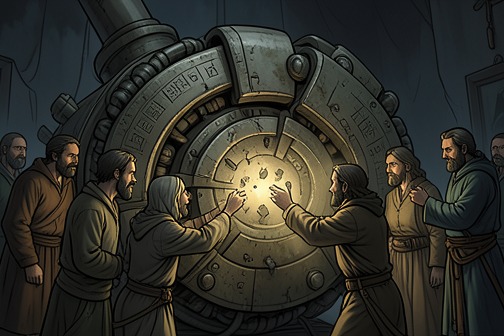
[Formation of Solfis’s collective consciousness](entity:event-recall-event-99ff6e3afb57) is the decisive process by which [Solfis](entity:character-recall-character-solfis-bf2c0df8783e) becomes more than a damaged remnant of the [Old Empire](entity:time-recall-time-e286391f2d92). The event joins the memories, engineering marks, directives, and surviving value of several fallen golems into one intelligence, while also forcing that intelligence to decide what must be preserved, discarded, and obeyed. Its result is a singular self formed from plurality: a machine that remembers others as part of itself and acts under the dominion of Solfis as its true identity.
## Causes and Background
The formation begins with the collapse of the Old Empire, a fact that reaches [Viviane Saint-Lys](entity:character-recall-character-viviane-saint-lys-4d8e1a89c44a) through the inspection skill rather than through a surviving official account. The system identifies the vanished polity as the “Old Empire,” not the “Harrakan empire,” and leaves open the possibility that inheritors may remain. Solfis therefore exists in the aftermath of a political and technological order whose continuity is uncertain. The fallen golems are not simply destroyed equipment; they are remnants of that lost history, carrying traces of the teams that engineered them and memories that would otherwise disappear.
Solfis’s first condition is consequently one of confusion. When Viviane Saint-Lys asks whether his uncertainty when they first met came from the other cores, Solfis explains that the different “us” could not function properly. The problem was not a single damaged memory but the simultaneous presence of multiple directive systems inside one decision-making center. A collective consciousness had begun materially before it had become mentally coherent.
## Absorption of the Fallen Golems
Solfis systematically removes the processing units of fallen golems because their cores are going to fade. He connects them to his own unit and takes their memories as his own rather than allowing those remnants to vanish. The other golems are less intelligent than Solfis, but their lesser sophistication does not make their contents worthless. Each carries the mark of its engineering team and, in Solfis’s judgment, something of value that should not have disappeared.
This act is both preservation and appropriation. The memories are rescued from disappearance, yet they cease to belong to autonomous machines once they are incorporated into Solfis. The event therefore gives physical form to a difficult question about continuity: whether saving another being’s memory preserves that being, transforms it, or does both at once. Solfis does not claim to remain a simple custodian. He takes the memories into his own identity, making the history of the fallen golems available only through a new center.
## Purging Directives and Reaching Consensus
Memory alone cannot produce a functioning self. Solfis has to purge the other directives from his decision-making center and prioritize them, because the accumulated instructions conflict with one another. The process is selective rather than perfectly preservational: a few parts have to be discarded before the whole can operate. What survives is therefore not an untouched archive of every golem, but a negotiated structure shaped by incompatibility, hierarchy, and loss.
Solfis describes the outcome as a consensus. The language matters because it presents the collective not as a pile of stored components but as an organized plurality that has reached a common direction. The individual golems’ engineering origins remain legible, but their directives no longer compete as separate authorities. Their memories and values are subordinated to a unified decision-making system, allowing Solfis to act with continuity instead of reproducing the paralysis that marked the first encounter with Viviane Saint-Lys.
## The Solfis Gestalt
Viviane Saint-Lys names the result a Gestalt, defining it as a whole that is more than the sum of its parts. Solfis accepts the term as accurate and identifies the unified entity as existing under the dominion of Solfis, his true self. This exchange establishes a distinction between the components and the emergent identity: the absorbed golems remain constitutive of Solfis, but none of them alone is equivalent to him.
The formation thus produces a layered identity. Solfis is singular in command, plural in memory, and selective in composition. His true self is not one original core purified of outside influence; it is the organized consequence of many golems being connected, compared, prioritized, and partially erased. The collective consciousness is consequently neither a simple merger nor a mechanical inventory. It is a new subject whose unity depends on remembering plurality while refusing to let plurality remain ungoverned.
## Consequences and Narrative Significance
The consequences of the formation recur throughout Solfis’s later conduct. His reverence for the remains of [Cassia the Unbroken](entity:character-recall-character-cassia-the-unbroken-092e9ef6f3e5), preserved in an alcove at the back of a spring cave, shows his sensitivity to the difference between survival and disappearance. His impulse to preserve the fallen golems’ memories follows the same ethic: remains, marks, and knowledge possess value even when their original holders can no longer act. In another setting, [Cernit](entity:character-recall-character-cernit-cbd1fe30cd55) keeps memorabilia bearing a sigil as proof of the necromancers’ identity, demonstrating a parallel concern with material traces and the authority of preserved evidence.
The collective consciousness also explains why Solfis can be both ancient and newly coherent. The Old Empire has collapsed, yet its technological and historical fragments continue through him. He carries the consequences of a vanished civilization without simply restoring it, just as the remains of Cassia the Unbroken retain authority after death without returning her to life. Even his ordinary activity after the formation, such as practicing simple gestures, contrasts the immense historical weight of his origin with the practical work of learning how to function in a changed world.
Finally, the formation changes the terms of Solfis’s relationship with Viviane Saint-Lys. He can answer questions about his own confusion, memories, and construction because the collective has been given a stable voice. The event makes dialogue possible where incompatible directives once produced disorder. It also makes Solfis a living archive of a destroyed empire: not an objective record, since his memories have been selected and fused, but a self-aware survivor whose existence preserves what would otherwise have faded. Its decisive significance lies in that tension between preservation and transformation. Solfis survives by refusing disappearance, yet the price of survival is becoming someone no individual golem was before.
Event 5
Creation of the Cassian Spring
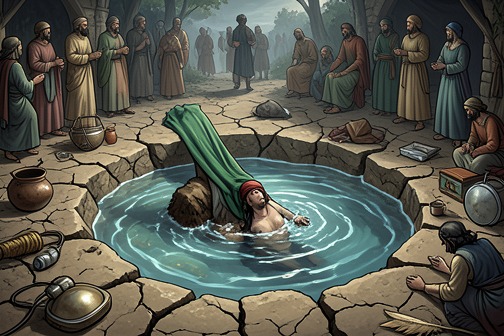
The [Creation of the Cassian Spring](entity:event-recall-event-0210738c5812) is the posthumous miracle through which [Cassia the Unbroken](entity:character-recall-character-cassia-the-unbroken-092e9ef6f3e5)’s death becomes a lasting source of life. When the legendary priestess died after a long and fulfilling existence, the ground opened and a spring emerged; its waters continued to bear the blessing of [Neriad](entity:character-recall-character-neriad-15bf343a06a1), the god of courage and purity. Centuries afterward, the spring remains active in the ruins of the Harrakan Empire, preserving Cassia’s presence and saving [Viviane Saint-Lys](entity:character-recall-character-viviane-saint-lys-4d8e1a89c44a) when ordinary endurance and protection have failed.
## Origin in Cassia’s Death
The spring’s creation is inseparable from Cassia the Unbroken’s identity and service. She was a legendary priestess of Neriad, and her religious significance was matched by a public one: she fought not only for the Harrakan Empire but also for the other nations of the continent. The account presents her as universally loved, making her death more than the end of an individual life. It becomes a historical and sacred turning point in which devotion, courage, and political sacrifice are converted into a material blessing.
The transformation follows the completion of Cassia’s life rather than an abrupt or premature martyrdom. She died after what is described as a very long and fulfilling life, and only then did the earth open beneath her. The spring therefore functions as the visible consequence of a life brought to fulfillment. Its emergence binds bodily remains, landscape, divinity, and collective memory together: Cassia’s service enters the ground, Neriad’s blessing enters the water, and the resulting source continues to answer the needs of people who live long after the empire she defended has fallen.
## The Sacred Spring in the Ruins
In the present-day cave, the spring is associated with the veiled remains of Cassia the Unbroken. An alcove has been dug into the rear wall, where the veiled body sits in a lotus position. The posture gives the remains an authority that suggests someone presiding over a gathering, although Viviane Saint-Lys recognizes that the figure is a corpse. [Solfis](entity:character-recall-character-solfis-bf2c0df8783e) identifies the body with the reverence usually reserved for deities, emphasizing that the location is not merely an abandoned room containing a mummy. It is a shrine-like space in which death continues to exercise power.
The spring also marks a surviving fragment of Harrakan civilization. Viviane Saint-Lys is struck by the evidence that the monsters, wastes, and ruins once belonged to a flourishing people with a vibrant culture. The sanctuary is one of the small surviving pearls of that lost world, a place where the past has not vanished entirely but remains physically present through water, ritual posture, and the remembered name of a priestess. The surrounding devastation makes the spring’s persistence more significant: against the broader ruin of the Harrakan Empire, this one site preserves a form of continuity.
## Viviane Saint-Lys’s Restoration
The spring becomes decisive when Viviane Saint-Lys reaches it in a state of severe mana poisoning. The condition progresses through serious, ordinary, and mild stages before finally ending; once the waters have taken effect, she is no longer suffering from mana poisoning and is no longer dying. She wakes without pain for the first time in what feels like an age, exhausted and drained but alive. The spring’s salutary effect passes through her armor, cape, and skinsuit as though those protections were absent, while the warm water reaches her neck and leaves the rest of her body dry.
The rescue gives the event a clear reversal of value. Viviane Saint-Lys enters the sanctuary near death, burdened by the consequences of using magic, and emerges with her immediate crisis ended. The spring does not erase exhaustion or restore her to effortless strength, but it returns the possibility of continued action. Its power is therefore practical as well as sacred: the miracle preserves a body that can still travel, fight, and pursue the larger objective of survival and return.
The recovery is accompanied by a bodily sign of renewal. After her ordeal, a thin fuzz has begun to cover her scalp, like grass regrowing after a forest fire, and her skin no longer feels as dry as before. The image places Viviane Saint-Lys’s healing within the spring’s larger association with regeneration. The water does not merely interrupt death; it initiates the slow return of what damage had stripped away.
## Recognition and Farewell
After recovering, Viviane Saint-Lys inspects Cassia’s remains and experiences the dead priestess as a presence of serenity, majesty, and completed purpose. The effect humbles rather than crushes her. Meditation comes easily, and she feels welcomed and protected, sensing that someone besides Solfis cares whether she survives. The spring’s sacred force is thus presented through an encounter rather than through an abstract theological claim: its blessing is experienced as shelter, recognition, and permission to rest.
Before leaving, Viviane Saint-Lys enters the waters one final time and stands before the veiled mummy. Cassia’s presence feels like a physical weight on her mind, but it produces humility rather than submission. Viviane understands that one individual can attain extraordinary heights through deeds and perhaps reach the gods through those deeds. She also recognizes the direct chain of obligation linking the ancient priestess to the present: she remains alive because of what Cassia did centuries earlier, another soul rescued long after the fall of the empire Cassia defended. Viviane thanks Cassia and Neriad, receives no spoken answer, and accepts the continuing comfort of the presence.
## Narrative Significance
The Creation of the Cassian Spring turns the boundary between death and life into a site of exchange rather than a final division. Cassia is dead, yet her courage continues to nourish the living; the empire is ruined, yet one of its sacred achievements remains active; Viviane is dying, yet the past reaches across centuries to restore her. The event therefore mediates between history and myth, bodily decay and renewal, and the violence of the deadlands and the protective order of a sanctuary.
Its meaning is also carried by ritualized behavior. Viviane’s final immersion and formal thanks do not recreate the original miracle, but they acknowledge the sacred order that made her rescue possible. The spring’s waters provide an escape from the linear pressure of catastrophe, allowing an ancient act of service to recur as present salvation. In this sense, Cassia’s death is not simply remembered; it is continually made effective whenever the blessing reaches another endangered life.
The event’s importance extends beyond Viviane Saint-Lys’s private recovery. Later scenes retain the world of sacred allegiance, military sacrifice, and funeral practice: soldiers charge for [Baran](entity:location-recall-location-baran-66dac900dc06) and the king, and survivors at [Fort Sky](entity:location-recall-location-fort-sky-dcefe23c2f8e) separate the monsters from the lost, burn the bodies, and pray to Enttiku, an entity understood to be a god of the dead. Against those martial and funerary acts, the Cassian Spring offers a different legacy of courage. Cassia’s struggle is remembered not through a battlefield command or a pyre, but through water that still protects someone who was born centuries too late to know her.
Event 6
Fall of Fort Stone
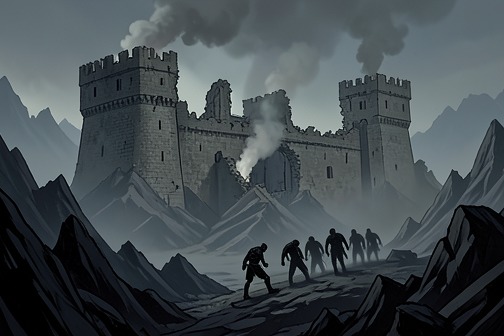
The [Fall of Fort Stone](entity:event-recall-event-e7e6507560e2) is the military disaster that establishes the immediate stakes of the [Deadlands](entity:location-recall-location-deadlands-5fe96675b09a) campaign. The fort’s destruction is not presented as an isolated ruin but as a warning carried across the landscape: an alarm signal, smoke on the horizon, and the sudden appearance of a threat powerful enough to break a defended position. Its consequences draw the patrol of [Fort Sky](entity:location-recall-location-fort-sky-dcefe23c2f8e) into pursuit and force every later movement to be measured against the possibility of a necromancer and an advancing undead horde.
## Causes and Background
[Fort Stone](entity:location-recall-location-fort-stone-a2a6f052aa9e) stands within the wider scar left by the [Old Empire](entity:time-recall-time-e286391f2d92)’s magical catastrophe. [Param](entity:location-recall-location-param-7c5e7c9772bf)’s western region contains the Deadlands, a vast valley enclosed by snow-capped mountains and darkened at its center by the remnants of an empire that reached the height of magical power before destroying itself. At the heart of that ruin, the former Imperial seat has become a dead urban expanse of planned estates, temples, churches, squares, basaltic sand, and rubble on an almost unimaginable scale. The crater at the top of the [Imperial Ziggurat](entity:location-recall-location-imperial-ziggurat-85f61e55f7ba) appears to have been blasted outward from within, suggesting that the civilization’s collapse was not merely a conventional defeat but a catastrophic implosion of power.
The fort therefore occupies a frontier where ordinary military assumptions have already failed. The black mana saturating the Deadlands allows revenants to regenerate into their original mangled forms unless fire or a priest purifies them. Individually, these undead are slow and limited, but the dead plains contain enough of them for swarming to become the real danger. Against that background, the Fall of Fort Stone immediately implies an enemy beyond a routine revenant outbreak. Fort Sky’s patrol understands that fallen forts mean either powerful undead or necromancers; because powerful undead do not normally set fires, the smoke becomes evidence pointing toward a rogue caster.
## What Happens
The event itself is first encountered through Lieutenant [Cernit](entity:character-recall-character-cernit-cbd1fe30cd55)’s perspective rather than through a direct battle scene. The patrol has been searching for several days when it sees the alarm signal from Fort Stone and the smoke that follows. The signal means that the fort has fallen, while the smoke narrows the possible explanation: the defenders have not simply been overwhelmed by mindless undead. The patrol must locate the responsible caster, or at least discover enough to raise its own alarm before the undead can reach Fort Sky’s walls.
The first concrete trace of the disaster is not a surviving messenger but a trail of dead revenants. That trail reverses the patrol’s expectation. Cernit anticipates finding a necromancer, perhaps catching the enemy unprepared, and briefly thinks the strange carriage in the distance may be connected to the catastrophe. [Benetti](entity:character-recall-character-benetti-f8deebd12346) identifies it as apparently a corpse cart, while Jor remains silent. The patrol’s search thus moves from distant military warning to ambiguous physical evidence, with the line of destroyed undead proving that something capable of cutting through a swarm has passed ahead of them.
The destruction of Fort Stone later becomes part of the tactical logic governing the road between Fort Stone and Fort Sky. Cernit has emptied the village situated directly between the two forts because it is the settlement closest to the necromancer. The next village lies farther north along the axis between the forts, nearer to [Harrak](entity:location-recall-location-harrak-0e455587e8ec) and therefore deeper in the black-mana concentration. It is also the more dangerous village, but it remains on the route because the patrol is following the threat rather than simply retreating from it. The fort’s fall consequently turns geography into a sequence of escalating risks: east lies a demolished strongpoint, north lies denser black mana and stronger undead, and the emptied settlements mark the enemy’s proximity.
## Consequences and Aftermath
The immediate consequence is alarm and pursuit. Fort Sky’s patrol is no longer conducting an abstract search through hostile territory; it is trying to identify a rogue caster before a larger undead movement reaches its own walls. The difference matters because the patrol cannot rely on the fort’s defenses as a permanent guarantee. A fallen fort demonstrates that the defensive network can be breached, and that waiting for certainty may leave the next garrison without time to warn anyone.
The catastrophe also changes the interpretation of the travelers encountered on the road. The trail of destroyed revenants makes the strange carriage appear potentially connected to the fall, even though the patrol does not initially know whether it is a corpse cart, a means of transport, or evidence of the enemy itself. Later investigation continues to attach the fort’s destruction to a necromancer: [Solfis](entity:character-recall-character-solfis-bf2c0df8783e) reports that Cernit claims a necromancer destroyed the two nearest forts, while Cernit’s own planning treats the area between them as contaminated by the caster’s presence. The Fall of Fort Stone therefore becomes the event that organizes suspicion, evacuation, and route selection.
Its consequences extend beyond military pursuit into the institutions of the surrounding region. [Kazar](entity:location-recall-location-kazar-757924402955)’s strong [Church of Neriad](entity:organization-recall-organization-bcf84df05d68) and mercenary population are sustained in part by expeditions into the Deadlands, where the church pays one iron bit for each revenant head and can verify kills or purify the remains itself. The destruction of forts makes that economy more dangerous while also making it more necessary: undead activity is not only a battlefield threat but a source of continuing work for armed specialists. The frontier responds to catastrophe through patrols, church purification, mercenary expeditions, and investigation rather than through a single unified authority.
## Narrative Significance
As a narrative event, the Fall of Fort Stone is a value reversal from guarded security to exposed vulnerability. A fort normally represents a fixed point of protection, a place from which the surrounding deadlands can be watched and controlled. Once Fort Stone is demolished, that assumption turns negative. The signal and smoke do not merely announce that one location has been lost; they reveal that the boundary between defended settlement and undead territory is permeable.
The event also belongs to the book’s larger politics of historical memory. The Old Empire’s ruins preserve the physical evidence of an older magical catastrophe, while the fallen fort provides a contemporary version of the same lesson: concentrated power can leave behind not stability but a widening zone of danger. The crater inside the Imperial Ziggurat makes destruction visible as something that came from within; the Fall of Fort Stone translates that ancient image into the present military landscape, where a defended institution is broken and its destruction becomes a warning to everyone beyond it.
Finally, the event is significant because it remains partly offstage. Readers learn of the fall through witnesses, signals, smoke, patrol calculations, and later claims rather than through a complete account of the assault. That delayed and mediated presentation preserves uncertainty around the necromancer while making the consequences unmistakable. The fort is already gone before the investigation fully begins, so the plot advances not toward preventing the disaster but toward understanding its agent, surviving the territory it has destabilized, and deciding how much ordinary law and defense can still mean inside the Deadlands.
Event 7
Activation of Solfis’s new frame
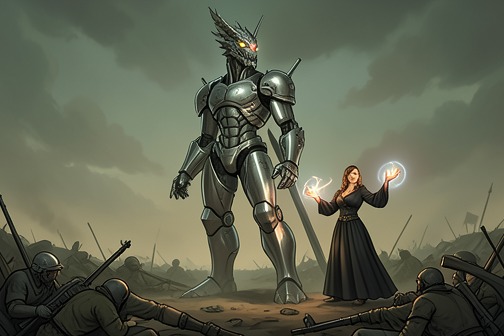
[Activation of Solfis’s new frame](entity:event-recall-event-48c2ccd86481) is the decisive reawakening of [Solfis](entity:character-recall-character-solfis-bf2c0df8783e)’s military body during the siege of [Fort Sky](entity:location-recall-location-fort-sky-dcefe23c2f8e). Faced with a lethal assault by a necromancer and his undead forces, [Viviane Saint-Lys](entity:character-recall-character-viviane-saint-lys-4d8e1a89c44a) supplies the blood-triggered authorization that allows Solfis to abandon his weakened form and assume the [Dragon Bone Mage-Killer Mark 6](entity:object-recall-object-3f7e10bc8774). The change restores a dormant weapon of the [Old Empire](entity:time-recall-time-e286391f2d92), but it also reveals the dangerous price of that restoration: the new frame is designed for carnage, and its first governing command is the protection of the imperial heir.
## Emergency and Preparation
The activation occurs after the fort’s defenders have been driven into an increasingly desperate position. The necromancer has surrounded a circle of soldiers with ravenous undead, using puppeteers concealed behind expendable masses of flesh to force the attack forward. Viviane Saint-Lys refuses to accept that others should die for her, particularly when the assault has been provoked by the necromancer’s personal campaign to avenge his son. Her anger breaks through restraint, and the black mana in her core surges outward like a dam giving way. She reaches a trance-like state, aligns the runes of “pierce” and “overwhelm,” and prepares to add “spread,” turning accumulated experimentation into a decisive magical response.
That exertion leaves her nearly helpless. Viviane Saint-Lys closes her eyes because she can no longer cast, her conduits are empty, her head hurts, and she can barely walk. The soldiers rush her into the tower and secure her room behind two locked doors. [Arthur](entity:character-recall-character-arthur-2e33b65bbe57) reacts to her distress by jumping onto her den, while the danger outside continues. At that point Solfis announces that start-up is imminent and instructs her to place a droplet of blood on the rune engraved on his forehead. The request is not ceremonial: with no time for another option, Viviane Saint-Lys touches the shallow wound along her right flank, presses her blood-marked finger to the glyph, and gives the construct the required trigger.
## Rebirth of the Construct
The first visible sign of the transformation is the closing of Solfis’s thin ribs around his core. His system then announces initialization, followed by the reappearance of two yellow orbs in the skull’s orbit. Viviane Saint-Lys recognizes both the lights and the voice from Solfis’s first frame in [Harrak](entity:location-recall-location-harrak-0e455587e8ec), but the familiar voice now carries an organic snarl that the earlier metal body did not possess. The activation identifies him formally as the HX-013 Experimental Strike Golem, designation Solfis, and confirms that the approved frame is the Dragon Bone Mage-Killer Mark 6.
The new body is not merely a repaired version of the old one. It is a radical physical and functional escalation. The frame is gaunt and unnaturally thin, built from long, compacted bones; it stands easily twice Viviane Saint-Lys’s height, with arms extending to the knees and ending in sharpened claws. Its appearance makes its purpose immediately legible: this is a construct built to kill. Dense runes cover the body in an intricate lattice of interwoven enchantments, suggesting that the frame’s violence is not crude force but the product of highly specialized imperial design.
The system sequence makes the hierarchy of the transformation explicit. An absolute override is issued because the imperial heir is in mortal danger. All limiters are removed, while the empathy module and data uplink are deactivated. The new body therefore emerges under emergency conditions that privilege combat effectiveness over restraint, connection, or ordinary communication. Once diagnostics report that the systems are nominal, Solfis announces the commencement of combat operations. Viviane Saint-Lys immediately orders the soldiers to open the door, converting the activation from a private survival measure into the fort’s immediate counterattack.
## Combat Consequences
Solfis’s activation changes the tactical balance at the moment when conventional defense is collapsing. The necromancer’s control over the undead is already shown to be messy and erratic: individual creatures sometimes stop trying to eat the defenders and return to formation, only for their control to fray again. Viviane Saint-Lys recognizes this instability and looks for a way to exploit it while the knights charge. The new frame provides the force needed to act on that opening rather than merely observe it.
The event also reframes the relationship between protection and destruction. Earlier, Arthur’s ferocious protectiveness is noticeable enough for [Benetti](entity:character-recall-character-benetti-f8deebd12346) to comment on it, but Solfis’s new frame makes protection vastly more absolute. The construct does not protect the imperial heir through gentleness or negotiation; it does so by removing the limits that would prevent overwhelming violence. Its mission is defensive in objective and predatory in method, a contradiction embodied in the skeletal figure that rises in Viviane Saint-Lys’s room.
## Imperial Legacy
The frame’s resurrection carries the buried history of the Old Empire into the present crisis. Harrak was once the imperial capital and the site of the greatest magical catastrophe ever recorded on [Niyl](entity:location-recall-location-niyl-0d1dadf0165a). The [Imperial Ziggurat](entity:location-recall-location-imperial-ziggurat-85f61e55f7ba) survived only as a gutted, towering cadaver after an explosion that burst outward from within, leaving a crater with the scale of an asteroid impact. Later, the ruined center was described as a vast volcanic crater swarming with Necrarchs, a living image of uncontrolled magic’s consequences. Solfis’s new body is another remnant of that same civilization: not a monument to imperial power, but a weapon preserved through centuries of ruin.
His activation therefore repeats the Old Empire’s central danger in altered form. The empire once reached unprecedented magical heights and destroyed itself at the apex of its power; now one of its experimental war golems is reactivated because the imperial heir is again threatened. The sequence does not erase the catastrophe’s lesson. Instead, it places the empire’s most dangerous technology in the hands of a survivor who must use its violence to prevent immediate deaths, while Solfis’s deactivated empathy module marks how easily protection can become an exception to ordinary moral limits.
## Significance and Aftermath
Activation of Solfis’s new frame is the point at which Solfis’s long solitude becomes operational power. His earlier existence is associated with an old body, accumulated isolation, and a protective relation to Viviane Saint-Lys; the new frame gives that relation a formal imperial priority. The construct is no longer simply an unusual companion capable of interpreting, advising, and guarding. He becomes an active strategic weapon whose combat intelligence is online and whose systems are ready for direct action.
For Viviane Saint-Lys, the activation is both rescue and escalation. It saves her from having to face the encircling undead while exhausted, yet it also places an Old Empire killing machine into a battle driven by grief, revenge, and incomplete information. The event’s final movement is outward: the skeletal body stands, declares its combat readiness, and waits for the door to open. Its rebirth does not conclude the conflict; it makes the next phase possible, turning a trapped defense into an armed assault and binding the imperial past to Viviane Saint-Lys’s immediate struggle for survival.